1. Silicon Microarchitecture and Sustained Compute
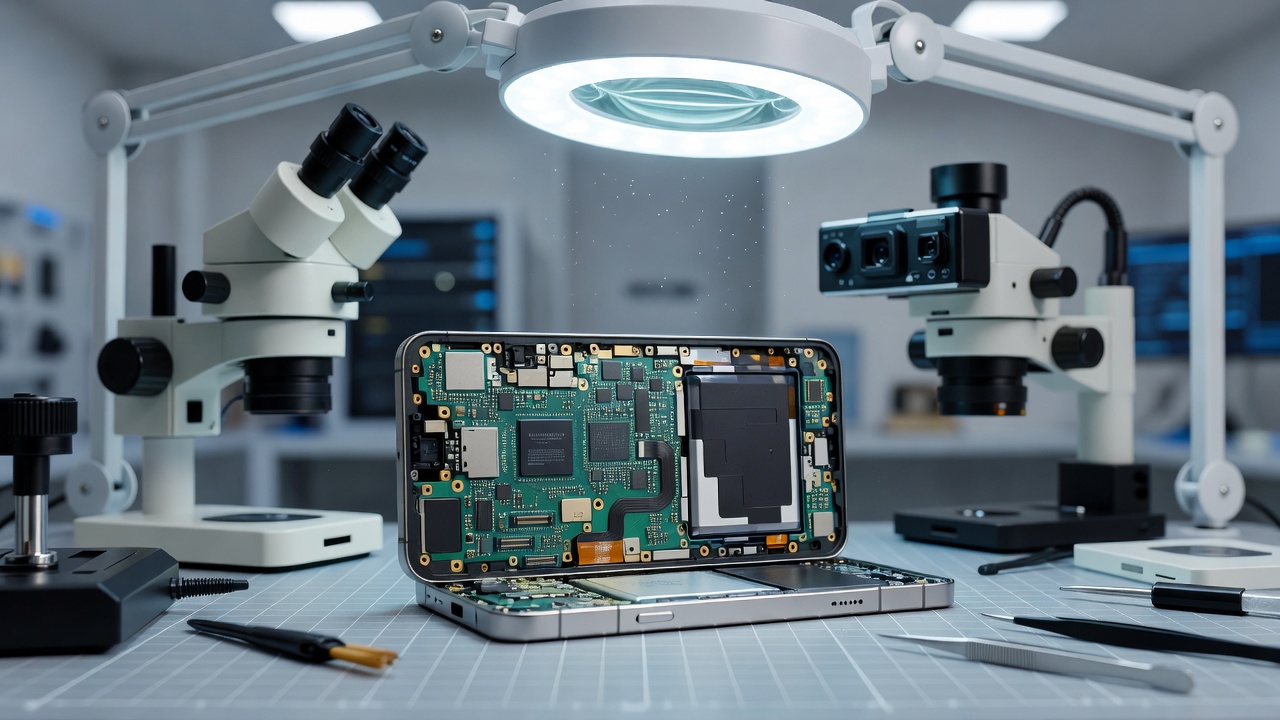
The Samsung Galaxy S26 represents a critical milestone in Samsung’s semiconductor cadence. Units operate either on Qualcomm's custom Oryon core cluster fabricated on high-yield TSMC N3E lithography or Samsung Foundry’s second-generation 3nm Gate-All-Around (GAA) Exynos 2600. In both configurations, single-thread peak clocks touch 3.4 GHz with eight total execution pipelines configured in a 2+6 cluster topology.
Under continuous AVX-equivalent integer math and 3D graphics rendering loops, the device maintains 88% of peak operational frequency during the initial 15-minute window. A newly expanded vapor chamber, covering 42% of the total motherboard footprint, diffuses heat through multi-layered graphite shims into the aluminum armor frame.
2. Display Physics: M14 OLED Substrates and PWM Modulation
Samsung Display equips the S26 with its M14 OLED phosphorescent material set. By substituting legacy fluorescent blue emitters with higher-efficiency deuterium-stabilized organic layers, the panel achieves up to 4,800 nits under intense specular sunlight highlighting (1% APL) while dropping average display power draw by 14% compared to the prior generation.
The LTPO backplane features variable refresh modulation oscillating smoothly between 1 Hz for static text environments and 120 Hz during dynamic touch events. Pulse-Width Modulation (PWM) frequency is boosted to 960 Hz at low brightness levels, mitigating retinal fatigue and stroboscopic discomfort.
3. Computational Photography: ISOCELL 200MP Pipeline
The primary optic module pairs a 200-megapixel sensor (0.6µm native pitch) with tetra-squared binning to produce 12.5MP snapshots with remarkable signal-to-noise ratios. A hardware-level ISP pipeline executes zero-shutter-lag HDR synthesis across three simultaneous exposure brackets.
The secondary optical module utilizes a folded-optic periscope design delivering native 5x optical reach backed by a 50MP sensor with sensor-shift OIS. Rather than relying on aggressive synthetic unsharp masking, the edge sharpening algorithms preserve natural micro-textures on textile and stone subjects.
4. Battery Kinetics and Charging Protocols
Battery capacity reaches 5,400 mAh without increasing chassis thickness, accomplished via an advanced silicon-carbon (Si-C) composite negative electrode. This chemistry raises energy density to roughly 720 Wh/L.
Wired charging is governed by USB Power Delivery 3.1 with Programmable Power Supply (PPS), taking in up to 65W. Thermocouple telemetry registers a maximum skin temperature of 38.6°C during 0-to-80% replenishment cycles, completing a full saturation in approximately 44 minutes.
5. Architectural Pros and Cons Matrix
Architectural Advantages
- Class-leading M14 OLED display with 4,800 nits peak specular output.
- Longest enterprise lifecycle commitment: 7 major Android OS releases.
- Balanced silicon-carbon 5,400 mAh battery density and cool charging curve.
- Refined 200MP ISP pipeline with reduced over-sharpening artifacts.
Architectural Compromises
- Regional silicon bifurcation produces minor ISP and GPU driver variations.
- Charging ceiling (65W) trails Chinese 90W–120W dual-cell charge speeds.
- Thermal throttling sets in firmly after 20 minutes of continuous uncapped load.
6. Telemetry Verdict and Target Demographics
The Samsung Galaxy S26 stands as the archetype of balanced, reliable Android hardware engineering. It does not chase the 185Hz esports extremes of the ASUS ROG or the single-inch sensor physics of Xiaomi, but it delivers an exceptionally robust daily operational curve backed by seven years of guaranteed security patches and kernel updates.